Lynne Baab
resources for personal spirituality
and for congregational leaders

search this site:






Life in Christ brings freedom, parts 3 and 4
Lynne Baab • Thursday July 2 2026
Overall theme from January until mid-July: God’s law is love
Lesson 12: Life in Christ brings freedom, parts 3 and 4 (Colossians 2:6-23)
Key verse: As you therefore have received Christ Jesus the Lord, continue to live your lives in him, rooted and built up in him and established in the faith. Colossians 2:6-7a.
Sinews and ligaments that connect us to the head
The relationship between inner faith and outer actions has been a topic of discussion and debate throughout Christian history. Paul here is addressing a particular component of the debate. He focuses primarily on the human tendency to criticize others based on what we see them doing, and in this passage, he is addressing the Colossians who are receiving criticism. The specific behaviors that are being criticized relate to lack of observance of the Jewish law, festivals, and traditions, as well as neglect of forms of strict bodily discipline and embrace of angels and visions. These have “an appearance of wisdom,” Paul admits, but these forms of “self-imposed piety . . . are of no value in checking self-indulgence” (Colossians 2:23).
Paul’s primary argument here is practical. The forms of piety that we generate ourselves — whether that involves pride at obeying rules, careful observance of traditions, or strict bodily discipline — simply don’t work as a way of helping us grow into the people God created us to be. Elsewhere in Galatians he explains why this is the case. God gave the law as a tutor, not as a source of life (Galatians 3:23-24). The tutor was put in place to set up limits both for protection and learning, but ultimately the law cannot justify. Here Paul notes that the law and other forms of strict self-discipline cannot make us better people.
Paul contrasts following Jewish tradition or Greek religious practices with “holding fast” to Jesus, who is the head of the body and “from whom the whole body, nourished and held together by its ligaments and sinews, grows with a growth that is from God” (Colossians 2:19). Growth and spiritual health come from connection to Jesus. In this practical argument, Paul seems to be saying, “People will give you all sorts of advice about how to live a spiritual life. People will criticize when you don’t follow their advice. Only one thing is necessary. Hold fast to Jesus.”
Many growth metaphors in the Bible rely on agricultural pictures of connection. In Psalm 1, the tree is planted by streams of water, and in John 15:1-11, the branches remain connected to the vine. Because of their connection, they bear fruit. Here in Colossians the growth metaphor relates to the physical body, where the ligaments and sinews support the body and keep it connected to the head, Jesus, who directs the growth and brings health. Paul charges the Colossians to focus on staying connected to the head rather than listening to critics. God invites us to hear those words, too.
What helps you cope with critical voices? Do you have different strategies depending on who says them or what words they say?
Stepping into the world
A human body grows for many reasons, including good food, clean water, sufficient movement, and because all the parts are connected to each other. According to Paul, spiritual growth happens when we are connected to the head of the body, Jesus. Christians throughout the ages have pondered how to nurture that connection.
Many Christians have looked to Psalm 1, where the person of faith is compared to a tree that bears fruit in its season. The identifying characteristic of this fruit-bearing person is joy in meditating on God’s truth. Many forms of Bible study and meditation, both communal and individual, have been essential in helping Christians stay connected to Jesus. Strong preaching has been a priority for two millennia. God’s word to us in the Bible is essential for drawing near to Jesus and living there.
Many Christians love the story of Mary and Martha in Luke 10:38-42. Martha is concerned with many tasks, while Mary sits at Jesus’s feet. “There is need of only one thing,” Jesus tells Martha (v. 42). Sit with me, be with me, and listen to me, Jesus seems to be telling Martha, like Mary has chosen to do. Countless books, classes, seminars, videos, and blog posts help us try to figure out what it looks like in real life to do exactly that. Spiritual practices from journaling and prayer walks to Sabbath keeping and fasting help Christians embrace a pattern of life that centers on being with Jesus. We do all of those spiritual practices with a spirit of connection and relationship, not with a desire to prove anything to ourselves, others, or God.
We stay connected to Jesus by embracing his values. We see Jesus touch a leper (Mark 1:40-45), and we wonder who God might be calling us to reach out to. We hear him talk at length with a Samaritan woman (John 4:1-42), and we wonder if God wants us to talk to someone across social and ethnic boundaries. We listen to Jesus tell his parable about the Good Samaritan (Luke 10:25-37), and we recognize that Jesus values helping relationships with unexpected people. The head of the body, Jesus, grows the sinews and ligaments in his church so that we can serve as he wants us to serve.
When people try to force us into a box that feels like it violates the values of Jesus, who we love, we can tell them “no” or refuse to listen. We stay connected to Jesus because we love him, not because we need to earn his love or gain the approval of others.
What helps you stay connected to Jesus, the One who already loves you? What helps you rest in God’s love?
֍ ֍ ֍
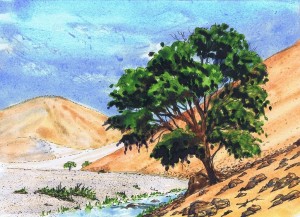
Next week: Liberty not license. Illustration by Dave Baab: The tree in Psalm 1.
This is the third to last post in a series that began in January. Some earlier posts:
- Jesus eats with a Pharisee (the first post in the series)
- The Sabbath, the law, and love
- Keeping the law inwardly
This lesson appeared in the Fall 2023 edition of The Present Word adult Bible study curriculum published by the Presbyterian Publishing Corporation. Used with permission.
֍ ֍ ֍
Two ways to subscribe.
If you’d like to receive an email when I post on this blog, sign up below under “subscribe.” That email and the posts on this blog are free and accessible for all.
If you’d like to help me cover the expenses for this blog and website, plus get a bonus post every month, you can subscribe on Patreon for $3 or $6 per month. My bonus posts focus on one or more of the hundreds of vivid quotations I’ve collected over five decades.
Next post »« Previous post
Subscribe to updates
To receive an email alert when a new post is published, simply enter your email address below.

Lynne M. Baab, Ph.D., is an author and adjunct professor. She has written numerous books, Bible study guides, and articles for magazines and journals. Lynne is passionate about prayer and other ways to draw near to God, and her writing conveys encouragement for readers to be their authentic selves before God. She encourages experimentation and lightness in Christian spiritual practices. Read more »
Quick links:
- Two latest books: Draw Near: A Lenten Devotional and Friendship, Listening and Empathy: A Prayer Guide (illustrated with Dave Baab's beautiful watercolors)
- Most popular book, Sabbath Keeping: Finding Freedom in the Rhythms of Rest (audiobook, paperback, and kindle)
- quick overview of all Lynne's books
- more than 50 articles Lynne has written for magazines on listening, Sabbath, fasting, spiritual growth, resilience for ministry, and congregational communication
You can listen to Lynne talk about these topics:
"Lynne's writing is beautiful. Her tone has such a note of hope and excitement about growth. It is gentle and affirming."
— a reader
"Dear Dr. Baab, You changed my life. It is only through God’s gift of the sabbath that I feel in my heart and soul that God loves me apart from anything I do."
— a reader of Sabbath Keeping
Subscribe
To receive an email alert when a new post is published, simply enter your email address below.
Featured posts
- Drawing Near to God with the Heart: first post of a series »
- Quotations I love: Henri Nouwen on being beloved »
- Worshipping God the Creator: the first post of a series »
- Sabbath Keeping a decade later: the first post of a series »
- Benedictine spirituality: the first post of a series »
- Celtic Christianity: the first post of a series »
- Holy Listening »
- A Cat with a Noble Character »
- Welcome to my website »
Tags
Archive
- October 2026 (1)
- September 2026 (6)
- August 2026 (4)
- July 2026 (5)
- June 2026 (5)
- May 2026 (5)
- April 2026 (3)
- March 2026 (3)
- February 2026 (2)
- January 2026 (6)
- December 2025 (6)
- November 2025 (4)
- October 2025 (3)
- September 2025 (5)
- August 2025 (4)
-
July 2025 (6)
- Praying about the flow of time: Praying about AND — again
- Praying about the flow of time: Praying for our ordinary lives
- Praying about the flow of time: Wind and water
- Praying about the flow of time: Paying attention to our stories
- What I learned from the past year's blog posts
- First post in a new series: Journey
- June 2025 (4)
- May 2025 (4)
- April 2025 (4)
- March 2025 (5)
- February 2025 (4)
- January 2025 (5)
- December 2024 (3)
-
November 2024 (5)
- Praying about the flow of time: Small actions with big benefits
- Praying about the flow of time: The overlap of the sacred and the ordinary
- Praying about the flow of time: The joy of the kingdom of God
- Praying about the flow of time: Advent can be confusing
- Praying about the flow of time: Why Jesus had to come
-
October 2024 (5)
- Praying about the flow of time: Rosh Hashanah, the Jewish New Year
- Praying about the flow of time: A month of celebrating renewal and moral responsibility
- Praying about the flow of time: The Feast of Tabernacles calls us to stay fluid and flexible
- Praying about the flow of time: Daily rhythms of prayer
- Praying about the flow of time: All Hallows Eve and All Saints Day
- September 2024 (3)
- August 2024 (5)
- July 2024 (3)
- June 2024 (5)
- May 2024 (5)
- April 2024 (4)
-
March 2024 (5)
- Friendship, loneliness, and prayer: Praying about distractions from empathy
- Friendship, loneliness, and prayer: Praying to keep empathy flowing
- Friendship, loneliness, and prayer: Everyday initiative
- Friendship, loneliness, and prayer: Praying for guidance for ending conversations
- Friendship, loneliness, and prayer: Reflecting on the series
- February 2024 (4)
- January 2024 (2)
-
December 2023 (6)
- Friendship, loneliness, and prayer: Initiating
- Friendship, loneliness, and prayer: Praying about listening roadblocks
- Friendship, loneliness, and prayer: Praying to love the poverty in our friends
- Friendship, loneliness, and prayer: Praying for “holy curiosity”
- Friendship, loneliness, and prayer: Praying for “holy listening”
- Friendship, loneliness, and prayer: Praying to give affection extravagantly
- November 2023 (4)
-
October 2023 (5)
- Friendship, loneliness and prayer: A listening skill with two purposes
- Friendship, loneliness, and prayer: Saying “thank you” to friends
- Friendship, loneliness, and prayer: One more way reflecting helps us
- Friendship, loneliness, and prayer: Lessons from two periods of loneliness
- Friendship, loneliness, and prayer: Types of reflecting, a listening skill
- September 2023 (4)
- August 2023 (4)
- July 2023 (5)
- June 2023 (3)
- May 2023 (6)
- April 2023 (4)
- March 2023 (4)
- February 2023 (4)
- January 2023 (4)
- December 2022 (5)
- November 2022 (1)
- October 2022 (5)
- September 2022 (5)
-
August 2022 (6)
- Draw near: Confessing sin without wallowing
- Draw near: A favorite prayer about peace, freedom, and much more
- Drawing near with Desmond Tutu: God’s love is the foundation for prayer
- Draw near: Worshipping God with Desmond Tutu
- Draw near: Yearning, beseeching and beholding with Desmond Tutu
- Draw near: Praising God with Desmond Tutu
- July 2022 (2)
- June 2022 (6)
- May 2022 (5)
- April 2022 (6)
- March 2022 (5)
- February 2022 (4)
- January 2022 (3)
- December 2021 (5)
- November 2021 (4)
- October 2021 (5)
- September 2021 (4)
- August 2021 (4)
- July 2021 (4)
- June 2021 (4)
- May 2021 (4)
- April 2021 (5)
- March 2021 (4)
- February 2021 (4)
- January 2021 (4)
- December 2020 (5)
- November 2020 (3)
- October 2020 (5)
- September 2020 (4)
- August 2020 (4)
- July 2020 (5)
- June 2020 (4)
-
May 2020 (4)
- Spiritual diary of sheltering in place: The lifeline of separating thoughts from feelings
- Spiritual diary of sheltering in place: The lifeline of welcoming prayer
- Spiritual diary of sheltering in place: a kite string as a lifeline
- Spiritual diary of sheltering in place: The lifeline of God’s distant future
-
April 2020 (7)
- Spiritual diary of self-isolation: the lifeline of God’s constancy
- Spiritual diary of sheltering in place: The lifeline of accepting my place as a clay jar
- Spiritual diary of sheltering in place: the lifeline of memories
- Spiritual diary of sheltering in place: the lifeline of “Good” in “Good Friday”
- Spiritual diary of sheltering in place: The lifeline of “easier does not mean easy”
- Spiritual diary of sheltering in place: The lifeline of nature
- Spiritual diary of sheltering in place: the lifeline of God’s voice through the Bible
-
March 2020 (7)
- Important anniversaries in 2020: The first Earth Day in 1970
- Important anniversaries in 2020: Florence Nightingale was born in 1820
- Spiritual diary of self-isolation: Weeks 1 and 2
- Spiritual diary of self-isolation: God's grace as a lifeline
- Spiritual diary of self-isolation: The lifeline of limits on thoughts
- Spiritual diary of self-isolation: Wrestling with God for a blessing
- Spiritual diary of self-isolation: Responding to terror by listening to Jesus voice
- February 2020 (4)
- January 2020 (5)
- December 2019 (4)
- November 2019 (4)
- October 2019 (5)
- September 2019 (4)
- August 2019 (5)
- July 2019 (4)
- June 2019 (4)
- May 2019 (5)
- April 2019 (4)
- March 2019 (4)
- February 2019 (4)
-
January 2019 (5)
- Nurturing friendships in a cellphone world: Jesus as Friend
- Nurturing friendships in a cellphone world: Friendship with Christ and friendship with others
- Nurturing friendships in a cellphone world: Who is my neighbor?
- Nurturing friendships in a cellphone world: Friendship as action
- Nurturing friendships in a cellphone world: Hymns that describe friendship with God
- December 2018 (3)
-
November 2018 (5)
- Connections between the Bible and prayer: Sensory prayer in Revelation
- First post in a new series: Nurturing friendships in a cellphone world
- Nurturing friendships in a cellphone world: Strong opinions and responses
- Nurturing friendships in a cellphone world: My conversation partners about friendship
- Nurturing friendships in a cellphone world: Two views about communication technologies
- October 2018 (4)
- September 2018 (4)
-
August 2018 (5)
- Providing Christian Care in Our Time
- Providing Christian care in our time: Seven trends in pastoral care today
- Providing Christian Care in Our Time: Skills for Pastoral Care
- Providing Christian care: The importance of spiritual practices
- First post in a new series: Connections between the Bible and prayer
- July 2018 (4)
- June 2018 (4)
- May 2018 (5)
- April 2018 (4)
- March 2018 (5)
- February 2018 (4)
- January 2018 (4)
- December 2017 (5)
- November 2017 (4)
- October 2017 (4)
- September 2017 (5)
- August 2017 (4)
- July 2017 (4)
- June 2017 (4)
-
May 2017 (5)
- My new spiritual practice: Separating thoughts from feelings
- My new spiritual practice: Feeling the feelings
- My new spiritual practice: Coping with feelings that want to dominate
- My new spiritual practice: Dealing with “demonic” thoughts
- My new spiritual practice: Is self-compassion really appropriate for Christians?
- April 2017 (4)
- March 2017 (5)
- February 2017 (4)
- January 2017 (4)
- December 2016 (5)
- November 2016 (4)
- October 2016 (4)
- September 2016 (5)
- August 2016 (4)
- July 2016 (4)
- June 2016 (4)
- May 2016 (5)
- April 2016 (4)
- March 2016 (5)
- February 2016 (4)
- January 2016 (4)
- December 2015 (4)
- November 2015 (4)
- October 2015 (5)
- September 2015 (4)
- August 2015 (4)
- July 2015 (4)
- June 2015 (4)
- May 2015 (4)
- April 2015 (6)
- March 2015 (4)
- February 2015 (4)
- January 2015 (4)
- December 2014 (5)
- November 2014 (4)
- October 2014 (4)
- September 2014 (4)
- August 2014 (5)
- July 2014 (4)
- June 2014 (7)